.svg)


.avif)
.avif)


Unlike most software a team rolls out, eSign and eStamp come with a legal layer — adopting them isn't just a procurement or workflow call. That layer throws up a set of questions legal teams have to resolve themselves:
- Which eSign type is valid for this kind of document?
- Does this agreement even need stamping?
You won't find the answer in a single search — you have to read through the IT Act, Indian Stamp Act, etc.
So these questions pile up, stalling eSign and eStamp rollouts.
We've had these conversations with hundreds of in-house counsel. In this article, we'll answer the 10 most common questions every legal team asks.
1. Is eSign legally valid in India and do any agreements still require a wet signature?
Yes, eSign is legally valid under Indian law.
But documents mentioned in Schedule I of the IT Act cannot be eSigned, you have to do wet-ink signatures
- Negotiable instruments (other than a cheque, demand promissory note, or bill of exchange issued in favour of or endorsed by an RBI / NHB / SEBI / IRDAI / PFRDA-regulated entity)
- Powers of attorney (excluding PoAs that empower a regulated entity to act on behalf of the person executing them)
- Trusts as defined under the Indian Trusts Act, 1882
- Wills and other testamentary dispositions
Everything outside this list can be electronically signed.
So, in short: unless a document is in Schedule I, it can be signed electronically without needing any special law to explicitly permit it.
2. Does the type of eSign matter — Aadhaar, DSC, or virtual, and when does the method change the legal outcome?
Yes. It depends on the regulatory requirements.
If a document mandatorily requires a “signature” under law, then you can only use IT Act eSigns (Aadhaar eSign, DSC, DocSigner, PAN eSign). If a document does not mandatorily require “signature” then you can use any electronic method.
We are divide eSign types into 2 broad categories:
- Tier 1 — IT Act eSignatures. These get their validity from Section 5, which says that where a law mandates a signature, you can only execute that document digitally using an IT Act eSign.
There are four types: Aadhaar eSign, PAN eSign, DocSigner, and DSC token.
- Tier 2 — Any other electronic method. These rely on Section 10A, which validates contracts formed through electronic means where no specific electronic execution method is prescribed.
Examples, virtual, quick eSign, I consent clickwrap .
We have built a Matrix of Validity which you can use to get clarity
3. Can eSign be used for internal corporate documents like board resolutions and HR policies?
Yes. Internal corporate documents can be eSigned.
Since some provisions of the Companies Act specifically require a “signature” - you can use an IT Act eSign type
4. For high-value or specially regulated instruments — investor agreements, property deals, large-value contracts — is clickwrap enough or do you need DSC or physical execution?
We figure this out using two things:
- Validity — Is the eSign type you want to use allowed? Use the Matrix of Validity to see which type of eSign you can use.
- Enforceability — How easy is it to prove that the customer eSigned the agreement?
We've laid out how different types of signature perform here
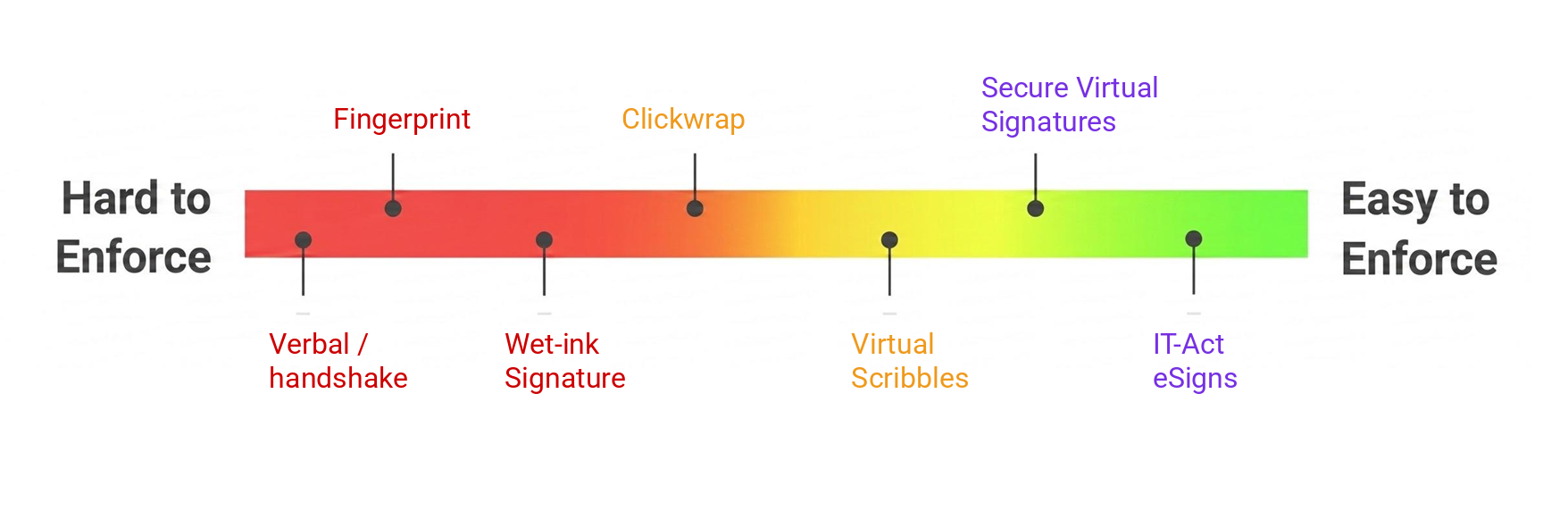
For such high value document, you would want to use an easy to enforce esign type so you can easily prove that the customer had esigned in case of dispute, like Aadhaar, DSC, or Doc Signer
5. Does eSign work when the signatory is sitting outside India?
Yes.
6. What must the audit trail contain to be admissible as primary evidence?
A secure audit trail should capture:
- Signer details — name and email ID
- Timestamp of each step of the eSign, for all parties
- IP address of the signer
- eSign type
- Signature certificate details (where an IT Act eSign is used)
- Security features used — e.g. geolocation, GPS coordinates, or live face capture, where added
7. When does a document need eStamping — and what can be signed with no stamp duty at all?
Here is a 3-step framework to find out if your agreement needs stamping:
Step 1: Is the document written - and does it create legal rights or liabilities?
Step 2: Check if the document needs stamp in State or India Stamp Act
Step 3: All executed written agreements should be treated as stampable unless specifically extempt
8. Does the stamp paper need to name specific parties, and what value should be used?
On parties: the first party's name is mandatory on the stamp paper — both the physical and the digital copy.
On value: refer to the relevant Stamp Act (the Indian Stamp Act, 1899 and the applicable state stamp act) for the correct duty for that instrument in that jurisdiction.
9. Who is legally responsible for paying stamp duty?
The contract itself can specify which party bears the stamp duty. If the contract is silent, you fall back to the relevant Stamp Act, which sets out the default responsibility for that instrument.
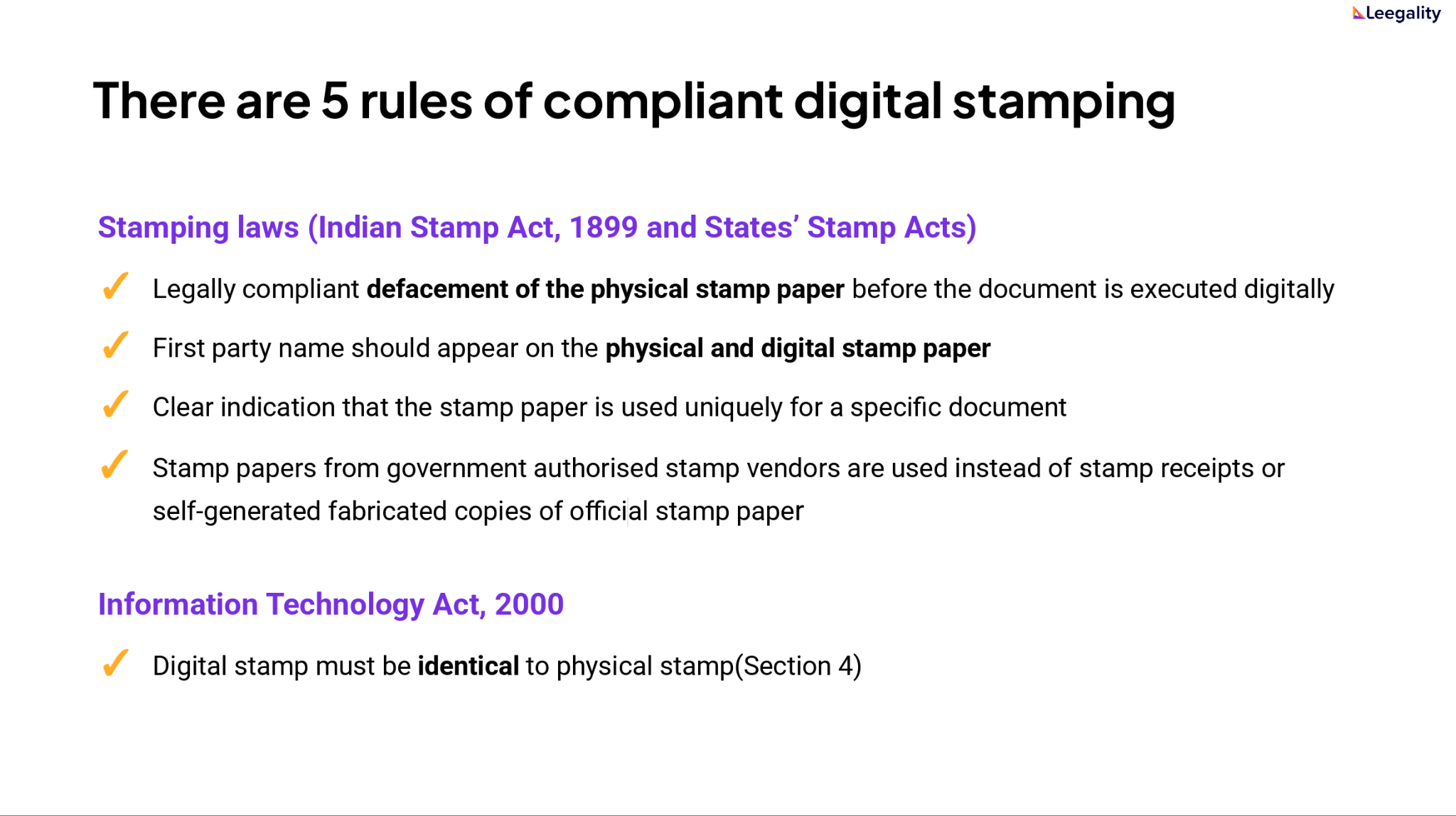
10. What must a digital stamping flow meet to be compliant?
Compliant digital stamping must meet 5 rules under both the stamping laws and the IT Act. Use this as a checklist: