.svg)


.avif)
.avif)


Invoices are often treated as routine paperwork. In reality, they sit at the intersection of law, money, and risk. Every invoice triggers a financial liability, a tax implication, and a potential dispute.
Yet, in most organisations, invoices still circulate as unsigned PDFs, scanned copies, or email attachments—documents that are easy to alter, hard to defend, and weak in audits.
This article explains why invoices should be eSigned, from a legal, audit, and enterprise-risk perspective.
1. An invoice is a legal assertion
At its core, an invoice is the seller’s formal assertion that:
- Goods or services were delivered
- The amount claimed is correct
- Payment is now due
Legally, this makes an invoice a statement of claim.
Without a signature, that claim lacks clear attribution.
An unsigned invoice raises basic legal questions:
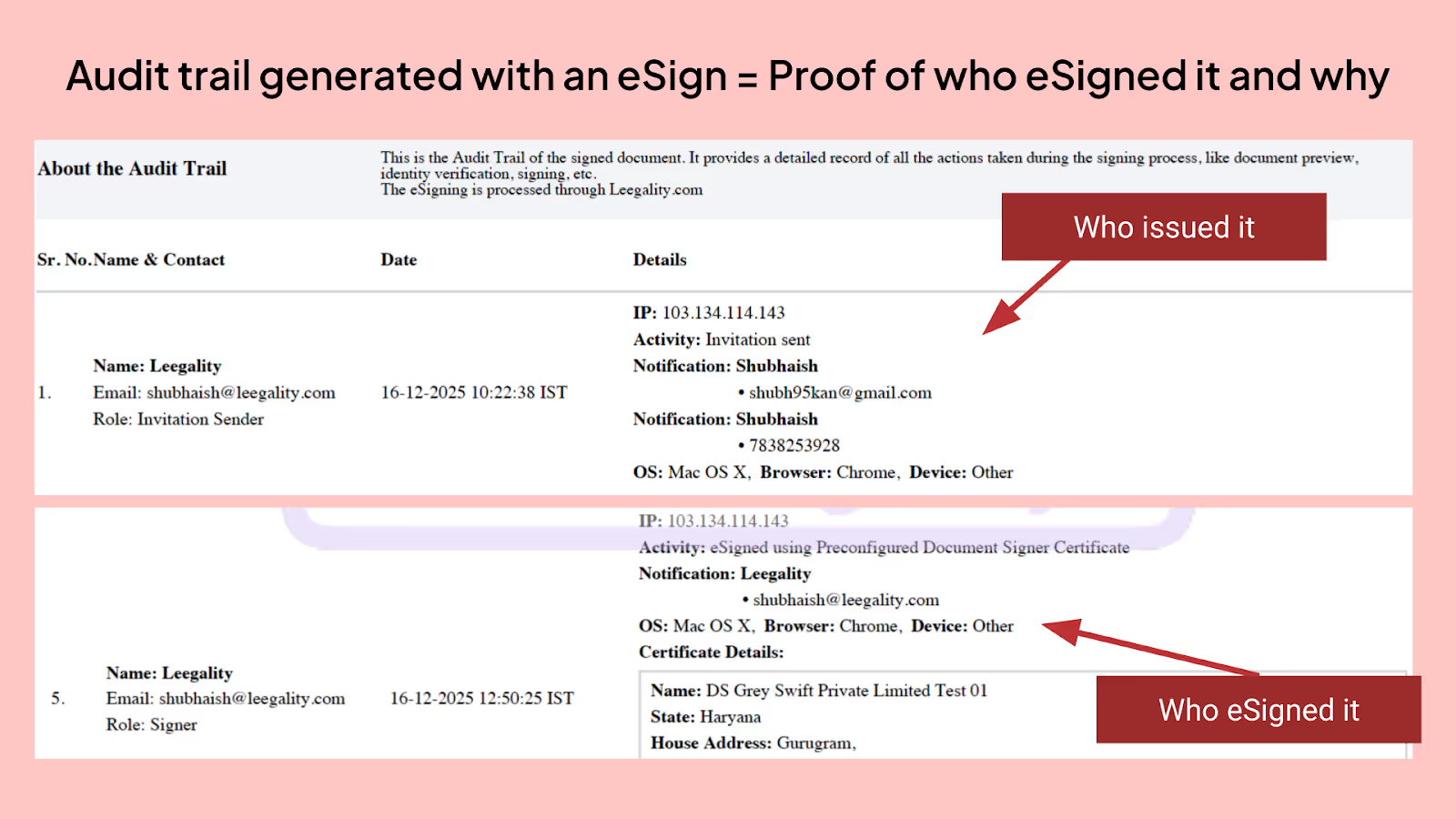
- Who issued this?
- Was it authorised?
- Was it altered after issuance?
- Can the issuer deny it later?
eSigning answers all of these.
2. Courts and Auditors Prefer eSigned Invoices
Under the new Bharatiya Sakshya Adhiniyam, 2023 (BSA) (previously Indian Evidence Act - Section 65B), electronic records are admissible in court — but their authenticity, integrity and non-repudiability determines the evidentiary weight.
The legal enforceability of any document depends on:
- How well it can establish the identity of the signer (Authentication)
- Whether the document can be altered after the signatures are affixed (Integrity)
- Whether the parties can deny their acceptance of the terms and conditions at a later stage (Non-repudiation)
(Learn more about it in our blog on legal enforceability of eSigns)
Compare 3 invoice types
| Invoice Type | Authentication | Integrity | Non-Repudiation |
|---|---|---|---|
| Unsigned Invoice |  No No |
No |
No |
| Invoice with Scanned signature | No |
 Easy to fake Easy to fake |
No |
| eSigned invoice |  Yes Yes |
Yes |
Yes |
An eSigned invoice provides:
- Identity of signer
- Timestamp
- Proof of integrity (tamper detection)
- Non-repudiation
In disputes, Non-repudiation is a decisive difference.
It means: The issuer cannot later deny issuing the document.
This is why finance teams often insist: “No signed invoice, no payment.”
3. Unsigned invoices are prone to fraud
Most invoice fraud involves:
- Edited amounts
- Changed bank details
- Duplicate submissions
- Resubmission of old invoices
Unsigned PDFs are easy to manipulate.
eSigned invoices are a preventive measure, not a cosmetic one because:
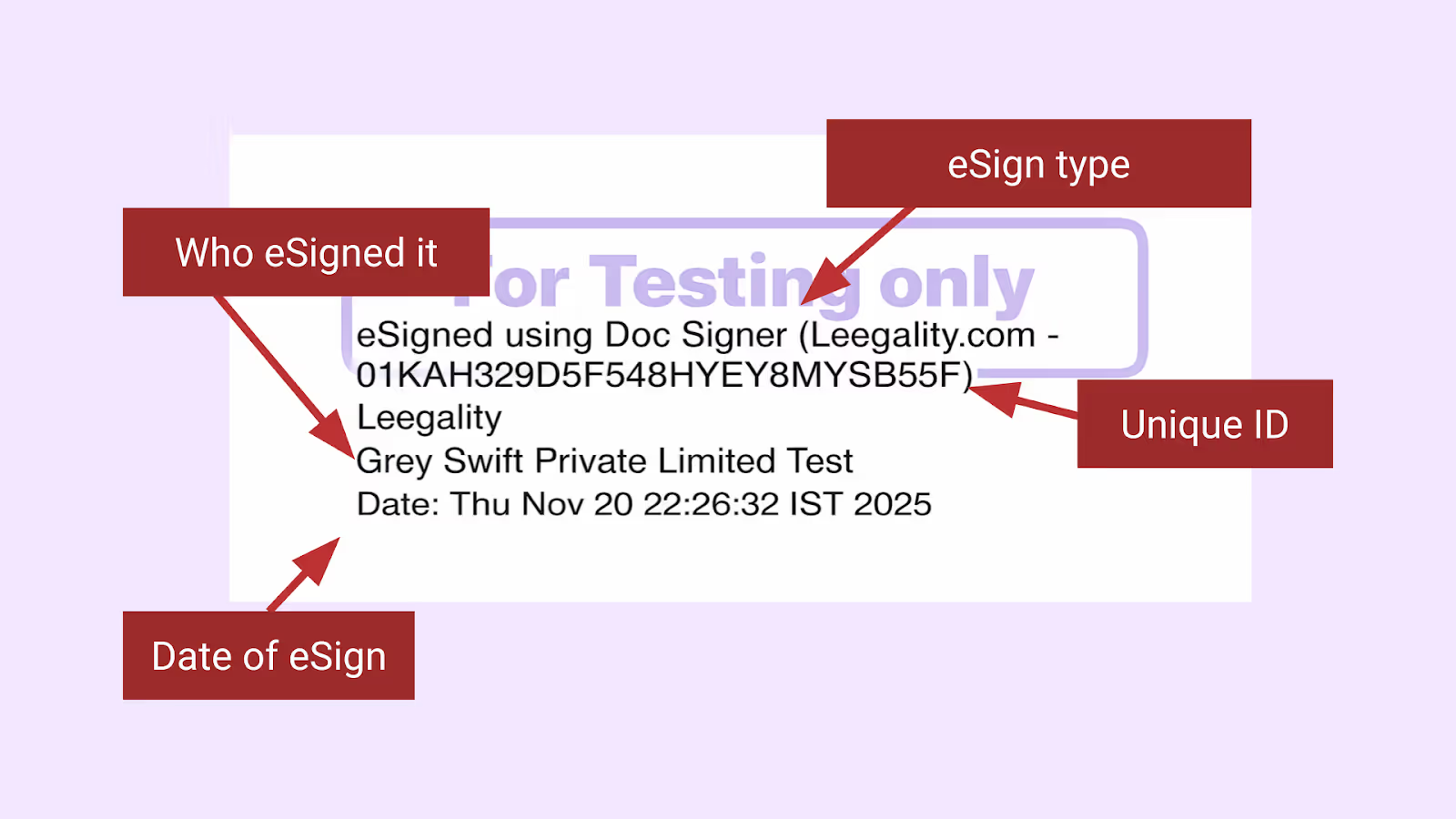
- eSign breaks if you edit the amounts or banking details
- Date of eSign will flag older invoices (if submitted)
- Document ID for eSign will flag duplicate invoices submitted
4. Audit Readiness and Internal Controls
Auditors look for three things:
- Authenticity – who issued it
- Integrity – was it altered
- Timing – did it exist before payment
eSigned invoices satisfy all three cleanly.
This reduces:
- Audit observations
- Manual explanations
- Reliance on email trails
In regulated sectors (banks, NBFCs, insurers, PSUs), this is often non-negotiable.
5. GST Compliance vs Commercial Risk (A Common Confusion)
“But I have an ERP system, which generates a unique ID number - that’s enough to satisfy the GST rules”
Rule 46 of the CGST Rules, 2017 states:
The invoice shall be signed by the supplier or his authorised representative,
provided that the signature or digital signature is NOT required in case of an invoice issued in accordance with the provisions of the Information Technology Act, 2000.
This means, GST law does may not require sales invoices to be signed if system-generated.
But here’s a critical point many teams miss: GST law governs tax compliance, not payment controls.
GST law only covers tax validity, not:
- Payment disputes
- Contractual liability
- Evidence in court
- Internal audit comfort
eSign is adopted not for GST, but for commercial and legal defensibility.
So when a company asks for a signed vendor invoice, they are not invoking GST law. They are invoking:
- Contract law
- Internal control policies
- Audit / risk requirements
The Bottom Line
Invoices trigger money movement. Money movement attracts risk.
eSigning invoices:
- Establishes legal ownership
- Prevents repudiation
- Strengthens evidence
- Reduces fraud
- Improves audit outcomes
- Removes paper without weakening control
eSign invoices with SignStation
As organisations scale, invoice signing quietly turns into a cost-center.
A company told us that they were quoted an annual fee of INR 65-70 Lakhs to digitally sign invoices.
SignStation cuts this cost by 50%.
SignStation by Leegality enables enterprises to digitally sign invoices at scale, without disrupting existing finance or ERP workflows.
With SignStation, you can:
- Automatically sign thousands of invoices via DocSigner
- Plug into your existing ERP
- Manage multiple DocSigners from a single dashboard
- Get an audit trail for every signed invoice